
The Proposals
Find out more about Qualitas Energy’s proposals for a new solar farm, located on land near Burton Lazars, Melton Mowbray, LE12 2UW.
Our proposal for Cuckoo Hill Solar Farm would deliver the following benefits:
Providing clean, affordable energy contributing towards energy security and helping address the cost of living crisis: The development will provide up to 40 MW of clean electricity to the grid – enough to power approximately 10,000 homes – thereby playing an important role in addressing the challenge of decreasing reliability on fossil fuels and other high emission energy sources.
Significant carbon savings: The green energy generated by the proposal will result in the avoidance of over 1,767,379 tonnes of carbon emissions over its 40-year operational lifetime, contributing towards national objectives to achieve net zero by 2050.
Increasing the long-term fertility of arable land: The project will improve the long-term fertility of arable land, enhancing future crop options whilst boosting the future agricultural potential of the land being developed on. This includes the establishment of a healthy soil eco-system, an increase in organic matter content and associated improvements in soil structure as a result of rural diversification.
Creating jobs and supporting the green economy: The proposal will create jobs during both the construction and operational phases, while supporting investment and growth of the green economy.
Native wildflower planting: Native wildflower planting and meadows will provide significant enhancements to on-site biodiversity.
Species-rich grassland: Species-rich grassland will be established beneath the solar panels, creating valuable habitat for wildlife.
Delivering significant Biodiversity Net Gain: The proposals will deliver significant benefit from a Biodiversity Net Gain of +73.99% in the provision of Habitat Units, substantially exceeding the statutory requirement of 10%.
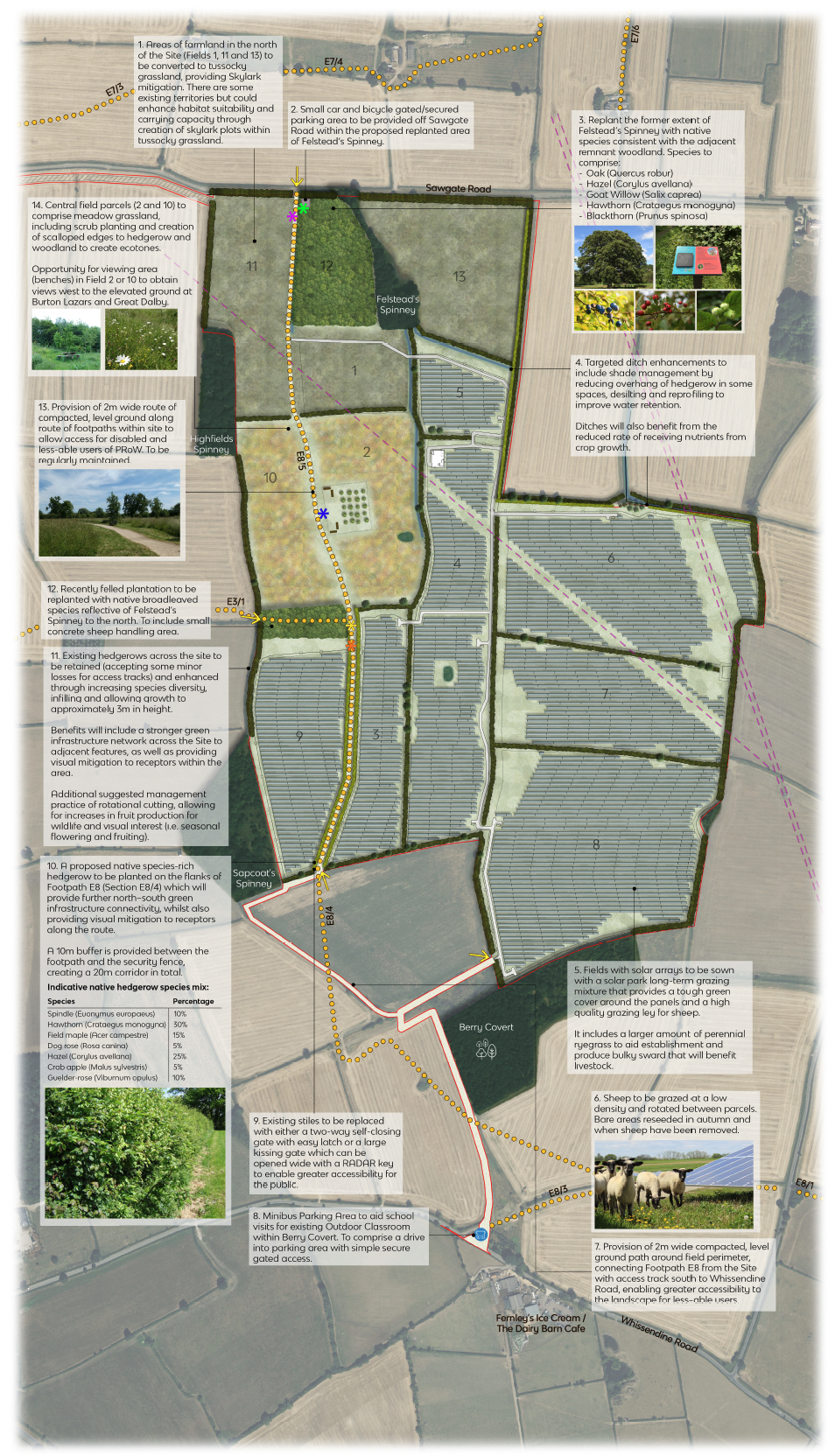
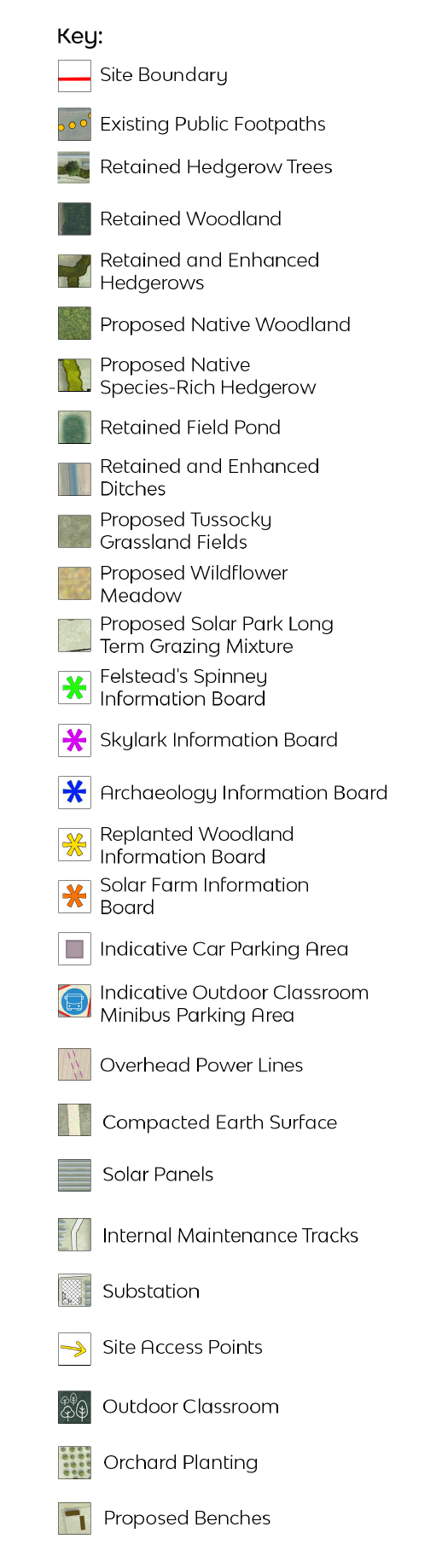
Interpretation and information boards to be provided along the Site’s PRoWs: This will support users’ understanding of solar panels and renewable energy, as well as the various biodiversity and landscape features of the Site, such as the reinstatement of Fetlstead Spinney, the presence of Skylark, the Site’s archaeological interest, and information about the re-planting of woodland that is being delivered. Boards will be aimed both at adults, and children.
The enhancement of facilities for walkers and the local community: This includes the provision of a new permissive path to the south, informal car parking spaces to the north and south of the Site, and the introduction of a seating area and orchard adjacent to footpath E8/5.
Supporting active travel: The provision of a minibus parking area to improve access for school children to visit the existing outdoor classroom in Berry Covert.
Implementation of natural flood management works: These will increase flood storage and reduce the flows leaving the Site, alongside improvement to water quality and create new habitats, contributing towards BNG and betterment of the existing drainage condition through the use of SuDS.
How has consultation feedback influenced the scheme design?
The feedback received through the consultation has helped shape the proposals. Following this engagement, a number of significant improvements and enhancements were made to the scheme ahead of the planning application being submitted:
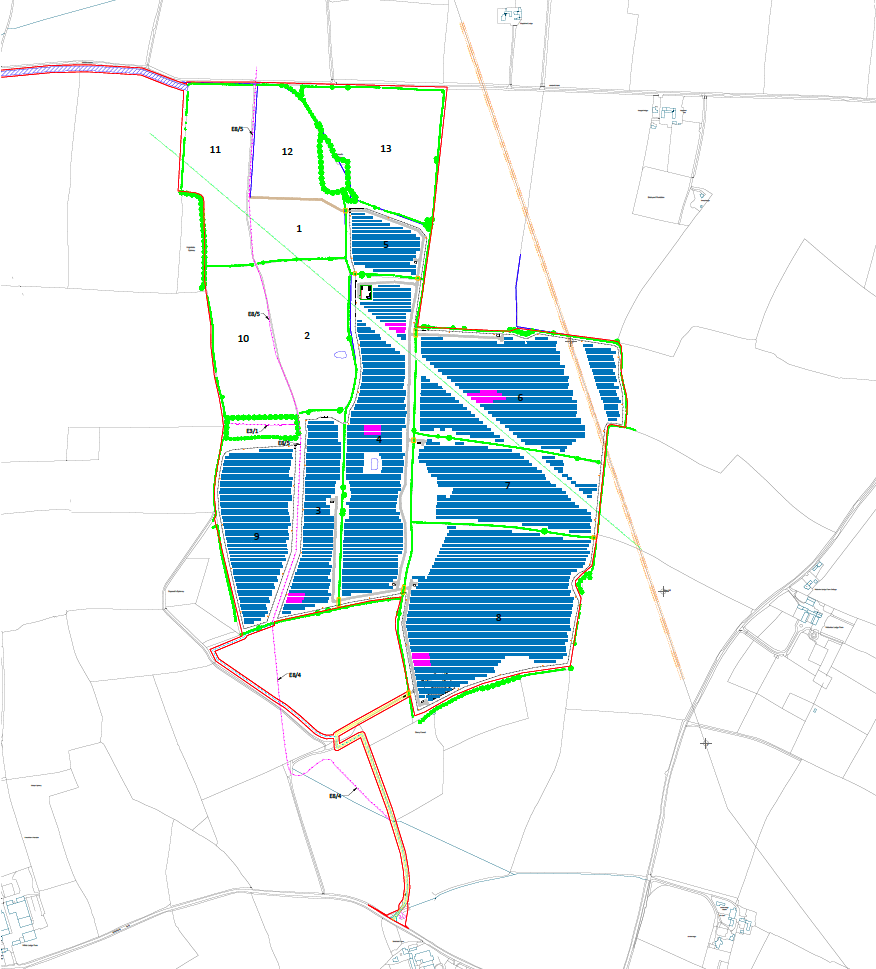
The complete removal of solar panels from three fields in the northern part of the Site, together with new and reinforcement hedgerow planting along the Site’s northern boundary, in order to reduce the proximity and visibility of the solar panels and security fencing from residential properties along Sawgate Road, and users of Sawgate Road.
The proposal of an entirely new construction and operational site access off Whissendine Road, addressing public concerns regarding the narrow nature of Sawgate Road and its potential unsuitability for construction traffic.
Introduction of a dedicated minibus parking area to support school visits to the existing Outdoor Classroom within Berry Covert, and to facilitate safer and more convenient access to the Site.
Replanting of the former historical extent of Felsted Spinney south of Sawgate Road with native species.
A comprehensive betterment to the condition and useability of the existing Public Rights of Way on the Site, and the addition of a permissive footpath route to extend public access.
Introduction of benches and signage to improve accessibility for disabled and less able users, and the recreational experience for all users;
Improvements to path surfacing to increase accessibility for all users; and
Existing gate styles to be replaced with either a two-way self-closing gate with easy latch, or a large kissing gate which can be opened wide with a RADAR key, again to improve access for all users.
6. Amendments to better facilitate ongoing agricultural management of the Site, including provision of a sheep handling area, agricultural access routes and sufficient operational space for the movement of livestock around the site. The tenant farmer is supportive of low intensity sheep farming on the Site which also facilitates management of the new grassland.
7. Removal of solar panels from areas identified as having archaeological potential and the addition of concrete feet on other small areas of arrays in order to preserve archaeological remains.
8. Realignment of the underground cable route connecting the solar farm to Melton Mowbury Substation to avoid potential impacts on wildlife, trees, Burton Brook and areas within Flood Zones 2 and 3.
9. The provision of a small car parking area off Sawgate Road for users of the Public Rights of Way, such that cars will not need to park on road verges.
Why this site?

High solar irradiance.
Benefits from existing mature hedgerows which will be kept and enhanced to help screen the solar panels.
Small woodland copses located around the site also help deliver visual screening and provide an opportunity for the project to connect these important wildlife habitats up creating new green corridors.
Farmland is marginal quality, none of the fields are classified as “best and most versatile agricultural land” meaning that there is an opportunity to help restore soil health through resting the land.
Uses just 3.8% of the Little Dalby Estate, with minimal impact on the Estate as a whole.
The public footpaths on the site are located outside the solar panel areas and provide an opportunity to enhance their condition, use and deliver better footpath connectivity in the local area.
Not within a protected landscape, heritage or ecological area, or high flood-risk areas.
In close proximity to the Melton Mowbray substation, which has spare capacity to receive the generated renewable electricity, and allowing grid connection to be delivered via underground cabling, removing the need for any new pylons.
Public footpaths surrounding the site are located outside the solar panel areas, providing opportunities to improve their condition, accessibility, and connectivity within the local area.
What will it look like?
The infrastructure will include Solar PV arrays, underground cable route, access tracks, security fencing, DNO substation, transformers and CCTV.
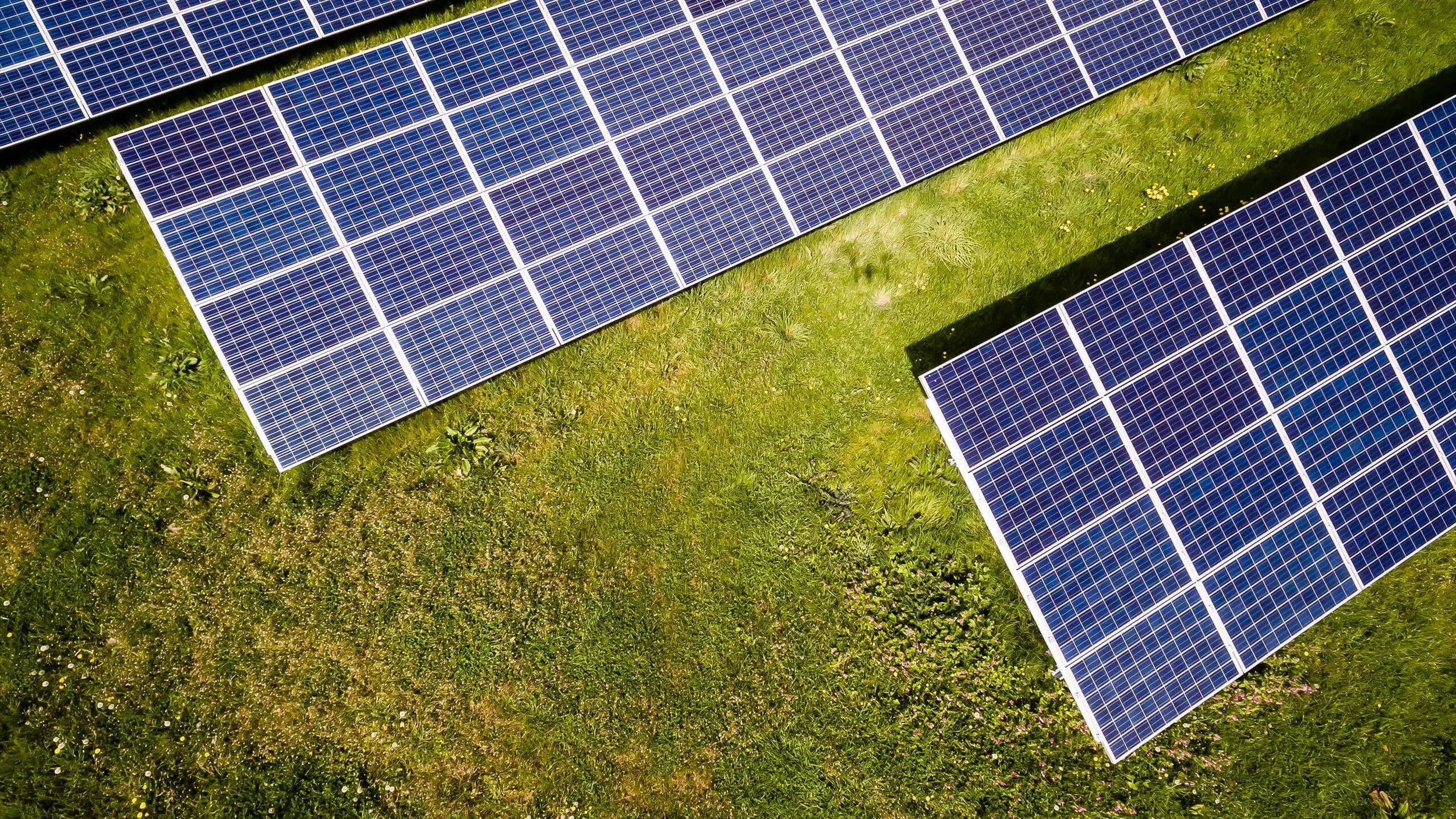
The development will include a fixed photovoltaic (PV) module system, with a tilt of around 20-25°. Solar arrays will be arranged in rows with gaps of approximately 3.5 m between each row. At the lower edge modules would be approximately 0.8 m from the ground and could be up to 3 m at their higher edge.
Landscaping including generous biodiversity enhancements are proposed to screen the development, and minimise impact on its surroundings. The scheme also includes other biodiversity and landscape enhancement measures to provide significant biodiversity net gain.
FAQs
-
A significant amount of land within the Cuckoo Hill Solar Farm red line boundary will be available for ecological enhancements, enabling the land to not only regain its natural biodiversity, but also to improve it.
Enhancements may include creating species-rich grassland and wildflower areas to support pollinators, planting new hedgerows, and improving the density and diversity of existing ones.
Biodiversity net gain will be achieved by working with qualified ecologists to survey existing habitats and develop a detailed Landscape and Environmental Management Plan to guide and maintain these improvements throughout the project’s lifespan.
Recent research by the University of Cambridge and the RSPB found that solar farms in East Anglia host more bird species and individuals per hectare than nearby arable land, including threatened species like Corn Buntings, Greenfinches, Yellowhammers and Linnets.
More detailed information on our ecology and landscape enhancements will be available at our consultation event.
-
Solar power plays a significant role in the UK economy. Beyond electricity generation, the deployment of both ground-mounted and rooftop solar creates a variety of local job opportunities, spanning installation, maintenance and manufacturing.
We urgently need to generate energy from new, low-cost, low-carbon sources, and solar is the lowest-cost and quickest to deploy of all energy technologies. UK energy production is also central to supporting long-term economic growth and resilience. Solar provides a low-carbon, renewable energy source that is both affordable and fast to deliver. It is therefore vital for strengthening the UK’s energy independence.
In addition, the project will directly benefit the local economy through business rates paid to Melton Borough Council, providing valuable additional income to support essential local services.
-
According to the 2025 UK Solar Roadmap, the biggest threat to food security is crop failure due to climate change, and solar farms are helping to tackle this directly. Solar and farming can be complementary, supporting each other financially, environmentally and through shared use of land.
Supported by the National Farmers’ Union, solar farms provide a valuable source of diversification income for farmers. This can improve the economic viability of farming businesses and make them more resilient to climate change impacts. Many solar projects are designed to enable continued livestock grazing.
Recent UK Government analysis shows that even under the most ambitious deployment scenarios, ground-mounted solar would only occupy up to around 0.6% of UK Utilised Agricultural Land by 2030.